


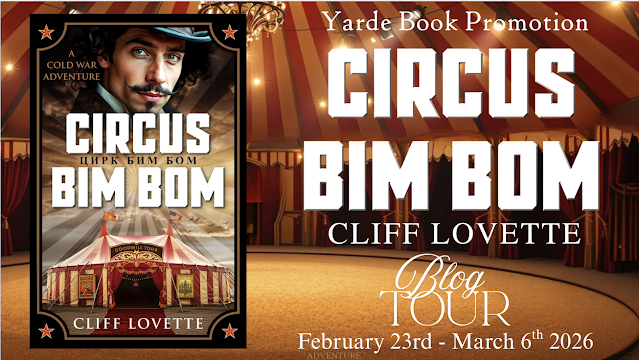
I’m delighted to welcome Cliff Lovette to my blog to tell us about Circus Bim Bom.
CIRCUS BIM BOM
By all accounts, the Soviet circus that toured America in 1990 was a small blip on the radar of the Cold War’s end. It barely received national news coverage. So how do I bring such an incidental event to life? How do I make readers care about people history forgot to record? The answer: I don’t just tell the story of the event. I tell the story of the people caught up in it.
Writing Circus Bim Bom required building two worlds simultaneously: the crumbling Soviet empire at a pivotal juncture when sworn enemies dared to envision peace, and the intimate, sensory world of circus life sawdust and sequins, animal musk and greasepaint, the roar of the crowd and the thrill of the high wire.
The Weight of History
President Gorbachev approved the newly formed Circus Bim Bom’s tour to showcase his Perestroika experiment—attempting to blend the best aspects of communism and capitalism while fostering cultural bridges across the Cold War divide. He wanted to impress upon President Bush and The West his genuine intentions to join the world community of peaceful nations. A pretty tall order for a humble circus.
That’s the macro world: superpowers negotiating, walls falling, an empire imploding. But readers don’t connect with geopolitics. They connect with a young aerialist who dreams of becoming a clown while his father insists he carry on the family tradition. They connect with performers who left families behind in bread lines, uncertain if they’ll get enough to eat.
Performers, Not Bystanders
The performers couldn’t just be bystanders to history. They had to be active participants—people with skills, relationships, dreams, and fears. And this circus faced a unique challenge: it was assembled specifically for this tour. These performers had never worked together before. They arrived in America as strangers. Then disaster struck. The USDA quarantined their animals in Brooklyn—no health certificates, no release. The trainers erupted. “We start rehearsals tomorrow, da? With what?” To build the world of the animal trainers, I immersed myself in their relationships with their animals. When the creatures finally arrived, they were traumatized. A young bear named Gorki engaged in repetitive head-banging. Masha gnawed steel bars until blood stained the floor. The big cats’ ribs showed through matted fur. Through the trainers’ eyes, readers experience the bond between human and animal— and the moral complexity of circus life. “These cats are family,” one trainer insists. “They seek our affection, our touch. We love them.” Another admits the dark side:
unscrupulous circuses that drown imperfect animals or sell them to illegal traders. The world I built isn’t simple. Neither were these people.
The Moment They Became Family
Every circus needs its turning point—the moment when a collection of individuals becomes a troupe. For Bim Bom, it happened during a rehearsal break when someone started playing an accordion. The song was “Dorogoi Dlinnoyu”—an old Russian folk tune that Western audiences know as “Those Were the Days.” The circus director watched from the sidelines as his fragmented company found unity in song and dance. Russians, Georgians, Ukrainians, Kazakhs, Azerbaijanis, Americans—all sharing the language of movement and wistful singing. The harsh work lights dimmed until only a single spotlight remained, catching the flash of whirling bodies and the sparkle of costume jewelry. When the last note faded, scattered footprints in the sawdust were the only evidence of what had happened. That scene required no explanation of Cold War politics. The world-building happened through sensory detail—the smell of sawdust, the blur of spinning skirts, the exhausted laughter of performers who had been strangers hours before.
Making Small Events Matter
The Ringmaster promises this: “The best Soviet stories are like vodka—they burn with suffering, intoxicate with conflict, keep you stewing in reflection, and yearning for your heart’s desire.” A Soviet circus touring America during the empire’s final months wasn’t front-page news. But for the performers caught between two worlds, facing authoritarianism at home and an uncertain future in a land of freedom, every choice carried weight. That’s my task: to find the human drama in forgotten corners of history. To build worlds so vivid that readers smell the animal musk, hear the roar of the crowd, and share their exhilaration and fear as they watch death-defying acts. To transform bystanders into performers.
☆☆☆☆☆
Circus Bim Bom: A Cold War Adventure launches March 1, 2026. The novel features over forty-five embedded links to period music, videos, and historical footage, allowing readers to hear the songs the performers danced to and watch the speeches that shaped their world. But world-building doesn’t stop at the page. At bimbombookclub.com, readers become part of the circus family. Twenty-five animated character avatars introduce themselves through video. The Historians’ Room invites readers to debate where history ends and imagination begins. Live chats and Zoom calls connect readers with their favorite characters—and each other. Because the best stories don’t just build worlds. They build communities.

Soviet circus performers arrived in America hoping to build cultural bridges. Instead, they became unwitting pawns in a Cold War game of international intrigue.
When the first privately owned Soviet circus arrived in 1990 in America as the Soviet Union disintegrated, its elite performers expected to build cultural bridges through spectacular shows. Instead, this prestigious troupe faced a perilous journey through Cold War America.
Circus director Yuri had to navigate treacherous waters where American mobsters, Soviet agents, and political forces circled like predators. Young aerialist Anton dreamed of becoming a clown against his family’s wishes, while forbidden romances and unexpected connections bloomed between Soviet performers and Americans who saw past the ideological divide. As high-stakes conspiracies threatened to tear the circus family apart, they had to choose between the authoritarian chains of home and the uncertain promise of freedom.
As the Ringmaster reminds us, “The best Soviet stories are like vodka—they burn with suffering, intoxicate with conflict, keep you stewing in reflection, and yearning for your heart’s desire.” This genre-bending tale explores whether human connection can transcend ideology—and whether storytelling can bridge the divides that separate us.

